Friday, May 18, 2012

Day 5 | Lasell Ecotourism 2012


Sunrise over the Rio Negro

Our early morning began at five o’clock in the morning for a sunrise contemplation. We took the motor boat out to the middle of a lake within the Rio Negro and we waited and watched as the sun came up from behind the trees.  It was a beautiful sight. The Amazon came alive as the birds chirped above us. The natives have recognized that certain birds chirp at specific times, therefore, Leandro knew that it was 6 o’clock when the toucan began to sing.

Our next activity was a three and a half hour jungle hike through the rainforest. Due to the high water level of the river, parts of the trail were flooded, which forced us to find a new starting point. When we reached the main trail, it was noticeably narrow. It was just enough for one person to walk on. This lessens the amount of damage to the plant life in the Amazon. The hike was very adventurous and included caves, rivers, fallen trees, and bats.

On our way back to the lodge, we made two stops. We first visited a watch tower that had an amazing view of the river and rainforest and was a great photo opportunity. After eating lunch and taking a short swim, we headed to our next stop. It was a dolphin rehabilitation center in a village called Novo Airao where Leandro lives. One woman took the risk to care for wild dolphins that had been injured by local fisherman that once considered them pests. For sixteen years she has been feeding and caring for the pink dolphins, but also allows them to come and go freely. The dolphins are able to survive with her help, yet they still have the ability to live in the wild. As a group, we were able to have close interaction with the dolphins. We sat low to the water as the owner fed them. As they came up out of the water to eat, we were able to pet their soft bellies. The type of interaction that visitors are allowed to have with the dolphins has changed over the years. In years past, people swam with and fed numerous amounts of fish to the dolphins. The people of the village have learned about ecotourism through the Anavilhanas National Park protection. They now know that this cannot continue. To keep the dolphins and people safe, tourists’ interaction is now limited. However, we were very lucky to have the opportunity to have contact with the pink dolphins. It was an amazing experience!  Tonight, we will be getting a good night’s sleep after a fun and exhausting day. Tomorrow we will be leaving the ecolodge and staying at a Non-Government Organization where we will have several volunteer opportunities. 
Hiking through the Amazon

Thursday, May 17, 2012

Day 4 | Lasell Ecotourism 2012


Today we took a 30 minute boat ride to the community of Tirirca’s Caboclo which is made up of only about 12 families. We had the opportunity to see a parrot and macaw snacking on a banana. We walked around and saw the various plant species that grew on their land. It seemed that almost every plant we came across had a different use or purpose which Leandro told us about.  One of the fruits we saw is used as a dye. Leandro painted designs on our arms with it. He later told us it would last two months! Leandro  has such an extensive knowledge because he is indigenous to an Amazonian Indian tribe called Macuxi.


A big part of ecotourism is helping the local community, which is why Anavilhana’s Ecolodge hires indigenous people to work as tour guides and other positions at the lodge. We visited the village’s gift shop which had handmade necklaces and earrings made out of nuts, berries, seeds, and beans. The money from the sales helps the tribe purchase things like school supplies and clothes. By purchasing gifts, tourists contribute to the wellbeing of the community while learning about their traditions. We then came back to the Ecolodge and met with the new General Manager, Fran, who has extensive education and business experience in ecotourism, which is her passion. Though she has only worked here for 20 days, she has many ideas to make ecolodges more sustainable by adding more solar panels, getting less polluting engines for boats, and creating a training program for the local employees. After meeting with the GM, we headed out on the boat again with our canoes in tow. We partnered up and paddled through another flooded forest, although some of us had some trouble maneuvering and ended up caught in branches. In a larger clearing, we were able to jump out of our canoes and swim around in the Rio Negro! At the end of the day we had a story telling session from Leandro on traditions such as the rites of passage for men and women in Indian tribes.  We have a long day planned tomorrow, so it’s time to get some sleep!

A photo of the Tirirca’s Caboclo Community from our boat. The yellow boat on the right is the school boat that the children take to school!


Wednesday, May 16, 2012

Day 3 | Lasell Ecotourism 2012


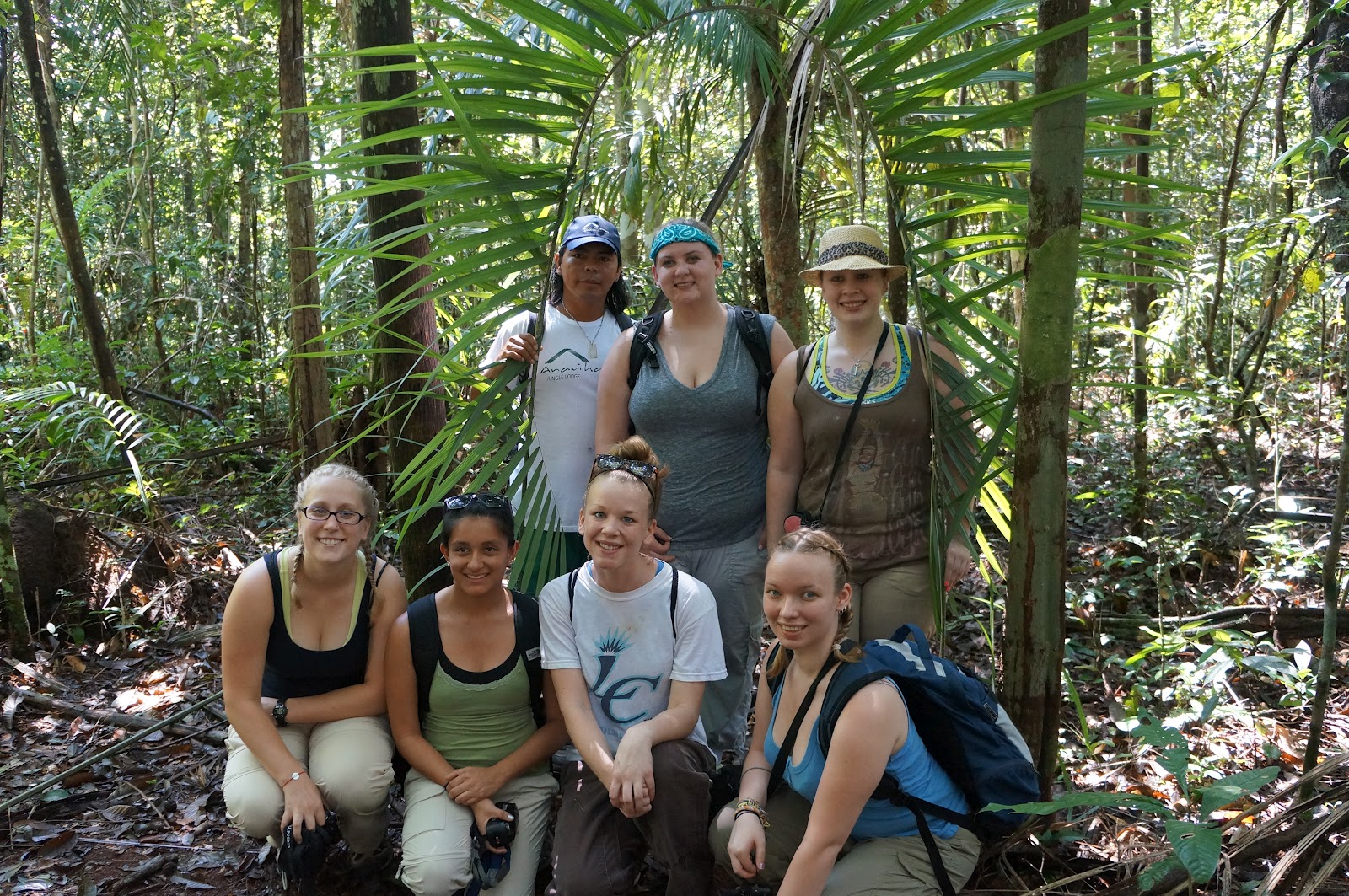
Posing under an archway Leandro made from palm branches.

Our first full day in the Amazon was very successful. We started our morning at breakfast, where we had wonderful home-grown food and fresh juice. Then we went off on a hike into the jungle, where we saw and learned about Amazonian wildlife. Some of the highlights of the hike were seeing army ants, a chameleon, and a fire caterpillar. At various points in the hike, we tasted a multitude of plants and wildlife too, including a bitter leaf, a flower from Leandro’s home that acts as a local anesthetic by numbing the mouth, and we all tried coconut grub, which is beetle larva inside a coconut shell. Most of us had the larva raw, but a couple of us tried the grub roasted from a hand-made fire. One of the most exciting things we saw on the hike was a young bird spider, which Leandro coerced out of its hole so that we could take turns touching and holding it. The bird spider gets its name because it often eats birds, and it isn’t poisonous, but does have a painful bite (fortunately, none of us experienced that). While we were hiking, we noticed older trails around us, but we remained on the new ones all day. As we learned in class, this helps prevent erosion; Creating new trails every couple of years allows the plants to re-grow on the older trails. To return from the hike, we canoed back to the lodge in pairs.

Our next activity was meeting with a government official from the Brazilian Ministry of Tourism. We learned their goals of continuing to increase tourism in Brazil and how they plan to do it in a sustainable way. After spending a semester learning about eco-tourism, it was interesting to get the Brazilian government’s perspective. In other countries they have developed tourism without thinking about sustainability. This makes it harder for these countries to try and address sustainable issues later. We’re hoping that Brazil continues to develop tourism sustainably. In the coming days we will be hearing other perspectives from people in the industry.

Our final adventure for the day was taking a boat through the flooded islands of the Rio Negro.  All throughout we saw many beautiful blue and green parrots and macaws flying over head. As we paddled through the trees, we ate some Amazonian grapes. When we saw a large 350 year old tree that had strong parasitic vines hanging from it, we all took turns swinging on the vines around the tree. We learned that this type of tree is the only one on the islands with wood suitable for building in the region.  That said, it’s illegal to cut it down. We enjoyed our day exploring the Amazon, and we’re looking forward to visiting a local Amazonian community tomorrow.
Christina holding the bird spider.

Tuesday, May 15, 2012

Days 1 and 2 | Lasell Ecotourism 2012

Our journey started when we loaded into the van Sunday afternoon to leave Lasell. The first flight to Miami went by very quickly, we landed around 9:30 pm and stopped for dinner before spending all of five hours in the hotel. We woke up at 4:30 the next morning to catch the shuttle to the airport but the check-in process went quickly so we were two hours early. During the flight, it was very different for all of us because we were the minority and all instructions were first announced in Portuguese. We finally landed after five long hours, only to be stuck in customs for another two. Our guide Leandro met us at the entrance of the airport in Manaus, Brazil where we took another shuttle for a two and half hour ride to our Jungle lodge. On the way, we got to drive across a four km bridge that was only opened six months ago. Before the bridge was built, the van would have had to wait for a ferry that would have taken an hour to cross the huge river.

Once we arrived we got a tour from an employee of the lodge that started with some great freshly squeezed juice from local fruits. Then we had our first view of the Rio Negro from the lodge and a great tower on the lodge property that was built for viewing birds and the scenery of the Amazon. All of these facilities are available to us 24 hours a day. We then broke off into our pairs and went to our cabins to get ready for dinner. Dinner was amazing and we all tried different foods that we had never heard of. Our favorite was a dessert; passion fruit mousse. We then got our cameras and hopped on our first boat ride out on The Rio Negro where Leandro used a flash light to spot eyes of different animals from a long distance. We saw a night jar, caimans, and moths. Our two most exciting sightings were a sloth that we got right underneath. The female three-tow sloth was looking straight down at us which made for some great pictures. The second was a tree boa which is a non-poisonous snake that some of us even got to touch. It was surprisingly smooth! We are looking forward for our hike tomorrow and what lies ahead for the rest of the week!

Monday, May 14, 2012

The trip has begun!

Professors Missy Van Hyfte and Dana Janbek will be taking students on a trip to explore the Amazon rainforest in Brazil through the eyes of both eco-tourists and tourism professionals. Six students were selected last fall to participate in the trip to Brazil that is part of Lasell’s International Service Learning Initiative (also known as the Shoulder to Shoulder program). This particular trip is part of a three credit course that students took throughout the spring semester in order to learn about the affects and implementation of tourism on the planet's eco-system.

The students (Natalie Couture, Corrine Cox, Sarah Hennessy, Catrina Joki, Rachel Robinson, and Krystina Vizard) have been studying the history, concepts, principles, planning, management, and development of ecotourism, which promotes cultural and environmental awareness and creates local environmental and economic benefits.Global, sustainable, ecotourism has been discussed at length in the class, with a look at the larger picture of tourism including approaches to delivering low impact development. Students have learned about holistic approaches to planning and tourism and reviewed standard industry practices and processes.  The culmination of the course is the educational trip to the Amazon rainforest to view, research, and participate in a newly developing eco-tourism system. Students will have the opportunity to meet with local tourism professionals, professionals from the Brazilian tourism of ministry, NGO leaders, members of indigenous Amazonian tribes, as well as discuss tourism development with the owner of the partnering eco-lodge (Anavilhanas Jungle Lodge). They will also be participating in work with local non-government organizations, teaching local children about tourism and it's affects, and participating in activities such as exploratory hikes through the jungle, navigating canoes through the flooded rainforest, feeding pink river dolphins, and night-spotting for indigenous species. Upon their return, the students will be planting trees indigenous to the Newton area in order to off-set the total carbon footprint of their exploratory trip. Additionally, they will be writing a blog about their experiences throughout their time in Brazil.

Photo from last year's ecotourism trip to Brazil.

Sunday, May 22, 2011

2011 | Day 5 - May 21st

Today was a day of closure and reflection. We started our day with a half hour boat ride to the Tiririca Village. While there, we were greeted by three beautiful birds, a macaw, a parrot and a fish hawk. Leandro told us that the village consists of 11 families that live off the land.  They make barbeque skewers out of wood and sell them in bundles of 3,000 for 50 Reals (Brazilian currency). He explained that recently there was a huge change in the Brazilian government that put strict laws in place to protect the environment. Villagers who made money from cutting trees and hunting are now prohibited from doing so.  They now sustain themselves in other ways, for example, creating jewelry for tourists from the lodge. The jewelry is created from different items collected from the forest such as tree nuts, acai berries, and straw.  This change in government policies has also helped with sending the children from the village to school. Each village now has a school boat that brings the children to and from school each day.  While there, Leandro also taught us about different ways these villagers live off their land by showing us all the plants and fruits that they use. Before we left the village, we purchased some jewelry which was a small contribution to the village’s economy.

                After lunch, our next excursion was to another non-government organization called Novo Airao Aana. The organization consists of people making hand woven crafts such as baskets, place mats, hats, purses, and vases out of natural materials.  Edy Vado, the director, spoke to us about the organization and explained that it is difficult to get the younger population to commit to their work. This is due to the complex process and painful handling associated with making these artifacts. There is also a dye that comes from a fruit grown locally that stains fingers.  We learned that they are using their by-products or waste materials to create new products.  This cuts down on their waste and makes the business more sustainable by adding more products from the same materials. 
                When we came back to the lodge, we sat down with Augusto Costa, the Anavilihanas owner and creator.  He explained to us how the lodge came to be and how much effort it took him to create such a successful eco-lodge.  It was interesting to learn how Anavilihanas is different from other Amazonian jungle lodges.  One of the lessons that we learned is that everything starts as a simple idea.  Augusto told us the story of how his idea turned into reality and how much hard work he needed to put in to make his dream come true.  To execute this idea he created a business plan which included comfortable accommodations with guided tours by local people.  By using the locals as guides, the guests get a glimpse of the Amazonian culture through their real life stories and experiences.  The stories that were shared by our guides helped give us a better idea about the environment and culture we’ve been living in for the past five days. 
                Our Amazonian adventure was filled with new experiences, new stories, and laughter. We treked through the jungle, fished for piranha, visted local villages, and most imporantly gained a unique perspective on ecotourism. This truly was a journey to remember!

Saturday, May 21, 2011

2011 | Day 4 - May 20th

Today was an exhausting day full of jungle trekking.  We traveled by boat for about an hour and a half and arrived at our hiking destination.  The boat pulled up to a local house where there used to be a cattle farm.  Due to the jaguars living in the jungle and the high cost to transport the cattle to Manaus, the cattle farmers could not continue cattle farming.  Now a hired family tends the land and house.  This family allows others to visit their land.  A pleasant surprise to all of us was the family’s pet monkey, Flora.  Normally, the locals do not take in wild animals as pets however, Flora was orphaned.  We learned that this is one way that wild animals become pets. 


                Our hike today was much more intense than our previous one.  We spent about four hours in the jungle spotting new creatures.  The trail was full of obstacles we had to overcome by working together.  We encountered fallen trees, roots, water, boulders, and mud.  Leandro showed us some survival tips such as how to roast a giant caterpillar.  Chico, our second Amazonian guide, started a fire using steel wool, a rock, and his machete as Leandro skewered the caterpillars.  To our surprise, the caterpillars did not taste too bad. 
                As we continued our hike, Leandro spotted an insect he had never seen before.  It looked similar to a ladybug however it was yellow with black spots and had red legs that resembled a spider’s.  Leandro asked us to give this new creature a name as he thought it had not yet been discovered.  We decided on “Laser,” our school mascot.  The end of our journey brought us to rock formations that made cave like paths.  Small streams and waterfalls ran through the paths and were refreshing after our long hike.  Two rock formations resembled a male and female hippo.  We learned that these rock formations, although home to creatures such as bats, can make excellent shelters if you were to get lost in the jungle. 
                We finished our adventure with lunch in a gazebo overlooking the Rio Negro.  In order to get to this gazebo, we had to climb a steep hill.  The climb was well worth it because of the beautiful view that could be seen from the top.  Leandro told us stories from his village while we ate.  It was interesting to hear his stories because they told about their faith system, myths, legends, and some of his personal experiences.  One of his experiences explained what motivated him to work with ecotourism.  When he lived in his village, he did not respect nature and was punished by the spirits.  After being taught a lesson by his tribe, he has been devoted to the environment ever since.  After filling up on sandwiches, we returned to the lodge.  It was an exhausting but incredibly rewarding day.